Library & Classroom Discussion Guide
A four-session guide for librarians, teachers, and community leaders to spark meaningful conversations about AI, algorithms, and everyday life.
A companion to The Invisible Score
- ~8 minute read
- Print Friendly
- Free Educational Resource
This guide is written for the adult in the room - the librarian, teacher, youth-services coordinator, or family facilitator running a discussion. It exists to make your job easier, not to add another lesson plan to your week.
The Invisible Score works best when it is read together and talked about together. The questions here are open-ended by design. They are meant to spark curiosity, invite disagreement, and give young readers permission to think out loud about the technology already shaping their lives.
You do not need to know the "right" answers. You only need to be willing to ask better questions.
How to Use This Guide
Each session below is designed to run in roughly 45 minutes and covers a small, digestible slice of the book. You can run all four sessions across a month, condense them into a single afternoon workshop, or pick the one that best fits your group. Nothing is prerequisite.
Session 1 - Recommendations & the Feed
This session focuses on how algorithms decide what we see - the videos suggested to us, the products we scroll past, the search results at the top of the page. Start light. Nobody needs to defend their screen time here.
Opening prompt (5 min): "What is the last thing an app recommended to you that felt scarily accurate?"
Session 2 - Data, Privacy & Digital Footprints
This session opens the black box a little. We look at what apps quietly collect, how a "digital footprint" grows over time, and what young readers can do to be intentional about the trails they leave.
Opening prompt (5 min): "If your phone kept a diary about you, what do you think the last entry would say?"
Session 3 - Bias, Fairness & Decisions That Affect Us
This is the most important session for older readers. It moves from "AI is fun" to "AI makes decisions about people." Grades 4-5 can handle it with gentle framing; middle schoolers usually take it further than we expect.
Opening prompt (5 min): "If a computer had to pick one person from your class for a prize, what should it look at? What should it never look at?"
Session 4 - Being a Responsible Digital Citizen
The closing session zooms out. Where does the reader go from here? What habits stay with them once the book is back on the shelf?
Opening prompt (5 min): "Name one habit around technology you would like to be known for."
Real-World AI Connections
Use these prompts to help readers connect the story to everyday systems they already interact with. Pick one or two per session as time allows.
- A streaming service recommending the next video you might like.
- A search engine deciding which results appear at the top.
- A game that adjusts its difficulty based on how you play.
- A photo app that suggests who to tag or which memory to relive.
- A homework or writing helper that finishes sentences for you.
- A translation tool that turns text from one language into another.
- A route app that decides the "best" way to get to school.
AI Around Us - A Worksheet
This is a take-home worksheet participants can complete between sessions or as a solo reflection. There are no right answers. Blank fields are intentional.
AI Around Us
- One place I noticed AI or an algorithm at work this week
- One decision it made for me (or on my behalf)
- One question I would like to ask the person who built this system
- One thing I want to change about how I use technology next week
- One thing I want to keep the same because it makes my life better
Final Reflection Activity
Close the discussion series with a short, low-stakes reflection. This is not a test; it is a chance for readers to hear their own thinking out loud.
“The goal is not to make young readers experts in artificial intelligence. It is to help them notice the systems already shaping their lives - and to feel curious, not powerless, about them.”
Additional AI Literacy Resources
Every companion resource on subhasit.com is free to download, print, and share. Use whichever one supports your next session, family conversation, or classroom activity.
- Parent Quick-Start Guide - simple conversation starters and family activities.
- Parent Discussion Guide - chapter-by-chapter prompts for families and book clubs.
- Student Reflection Questions - individual reflection prompts for young readers.
- AI Glossary - plain-language definitions of the most useful AI terms.
- Understanding the System - a short reading that unpacks how recommendation systems work.
- Digital Footprint Checklist - a printable one-pager to review with a young reader.
- Librarian Information Sheet - a program-planning summary for library and school teams.
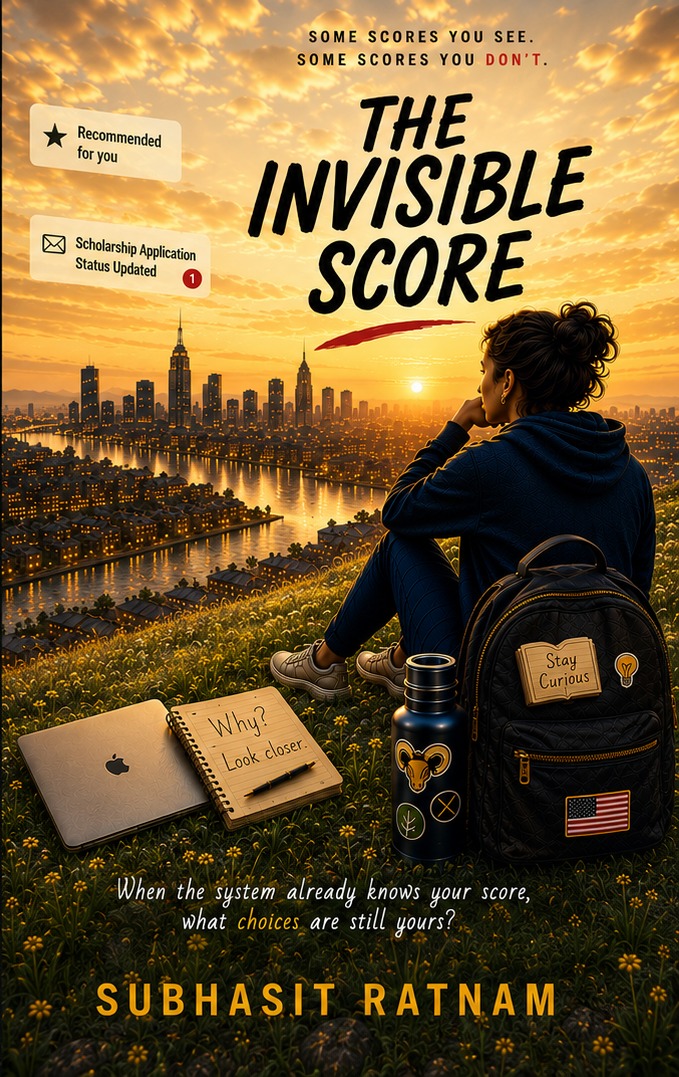
The Invisible Score
A story about the algorithms that quietly shape our lives.
Written for readers aged 9+ and their families, The Invisible Score follows Maya as she uncovers how AI, algorithms, and data quietly shape everyday decisions - through a story that stays with young readers long after the last page.
The Invisible Score
A story about the algorithms that quietly shape our lives.
Written for readers aged 9+ and their families, The Invisible Score follows Maya as she uncovers how AI, algorithms, and data quietly shape everyday decisions - through a story that stays with young readers long after the last page.
Learn more and get the book: www.subhasit.com/#book
Explore all free resources: www.subhasit.com/resources
- Librarian Information Sheet
A one-look program-planning summary for library and school teams.
- Parent Discussion Guide
Chapter-by-chapter conversation prompts families and book clubs love.
- All Resources
Explore every free educational resource by audience.
- The Invisible Score
Read the book that inspired every resource on this site.