Parent Discussion Guide
A warm, practical guide to help families talk about AI, algorithms, and everyday technology - one conversation at a time.
A companion to The Invisible Score
- ~6 minute read
- Print Friendly
- Free Educational Resource
This guide is for the parent, grandparent, or trusted adult who wants to have real conversations with their child about the technology in their life - without turning it into a lecture.
The goal is not to teach AI. It is to notice AI together, ask honest questions, and give your child permission to be curious out loud.
How to Use This Guide
Pick one section a week, or just one question a night at dinner. There is no correct order. There are no correct answers. You are modelling curiosity, not testing knowledge.
AI Conversation Starters
Soft openers. Save these for a car ride, a walk, or a quiet dinner. None of them require a right answer.
- What is the last thing an app recommended to you that felt scarily accurate?
- If your phone kept a diary about you, what would today’s entry say?
- When has a computer ever been unfair to you - even in a small way?
- What is a thing you would happily tell an app, and one you would rather it never knew?
- If you could design one rule every AI had to follow, what would it be?
Age-Appropriate Discussion Questions
Same big ideas, framed differently for different ages. Pick the row that fits your child today.
Everyday AI Your Child Meets
Point these out together as they happen. Naming the system is the first step to understanding it.
- A streaming service picking the next video.
- A search engine deciding which results appear first.
- A photo app suggesting who to tag.
- A homework helper that finishes sentences.
- A game that adjusts its difficulty as they play.
- A route app that decides the “best” way home.
- A social feed that ranks what they see and in what order.
Digital Citizenship Tips
- Ask before you post a photo of another person - including your own child.
- Pause before sharing anything that feels urgent, outrageous, or too perfect.
- Turn off one notification a week. Notice which ones you never miss.
- When you meet a new app, look for the settings page before you look for the main feature.
- Say “I am not sure this is real” out loud when you feel it. Model the doubt.
Online Safety Reminders
Family Activities
- The Feed Swap - trade phones for five minutes (with permission) and describe what you notice about each other’s feeds. Not the content, the pattern.
- Two-Search Test - each family member searches the same word on their own device. Compare the top three results. Discuss why they differ.
- Spot the Nudge - during 15 minutes of screen time, count how many times something (notification, auto-play, recommendation) tries to keep you there.
Screen Time Discussion Prompts
- When do you feel best after using your phone - and when do you feel worst?
- Which apps leave you happier than they found you? Which do not?
- What is a screen-time rule you would set for yourself if no one else did?
- Is there a time of day you wish your phone did not exist?
AI Myths vs Facts
Additional Resources
- Parent Quick-Start Guide - simple conversation starters and family activities.
- AI Glossary - plain-language definitions of AI terms your child may hear.
- Digital Footprint Checklist - a printable one-pager to review together.
- Understanding the System - a short reading on how recommendation systems work.
- Student Reflection Journal - a companion journal for your child.
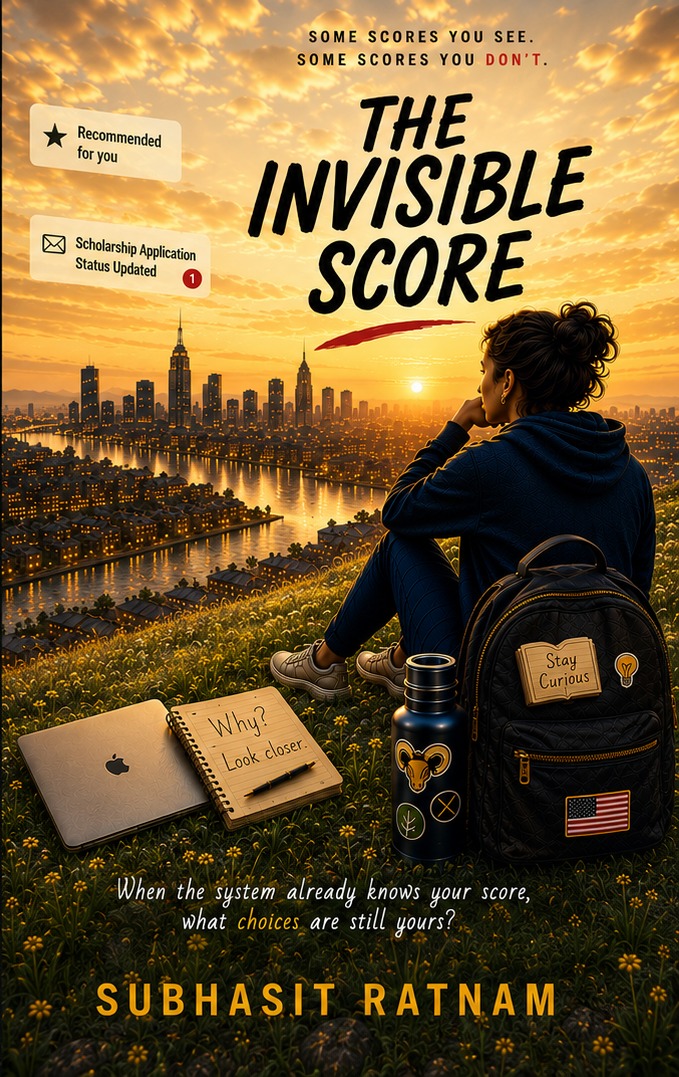
The Invisible Score
A story about the algorithms that quietly shape our lives.
Written for readers aged 9+ and their families, The Invisible Score follows Maya as she uncovers how AI, algorithms, and data quietly shape everyday decisions - through a story that stays with young readers long after the last page.
The Invisible Score
A story about the algorithms that quietly shape our lives.
Written for readers aged 9+ and their families, The Invisible Score follows Maya as she uncovers how AI, algorithms, and data quietly shape everyday decisions - through a story that stays with young readers long after the last page.
Learn more and get the book: www.subhasit.com/#book
Explore all free resources: www.subhasit.com/resources
- Parent Quick-Start Guide
Simple conversation starters and family activities.
- Student Reflection Journal
A companion reflection journal your child can use alongside this guide.
- All Resources
Explore every free educational resource by audience.
- The Invisible Score
Read the book that inspired every resource on this site.