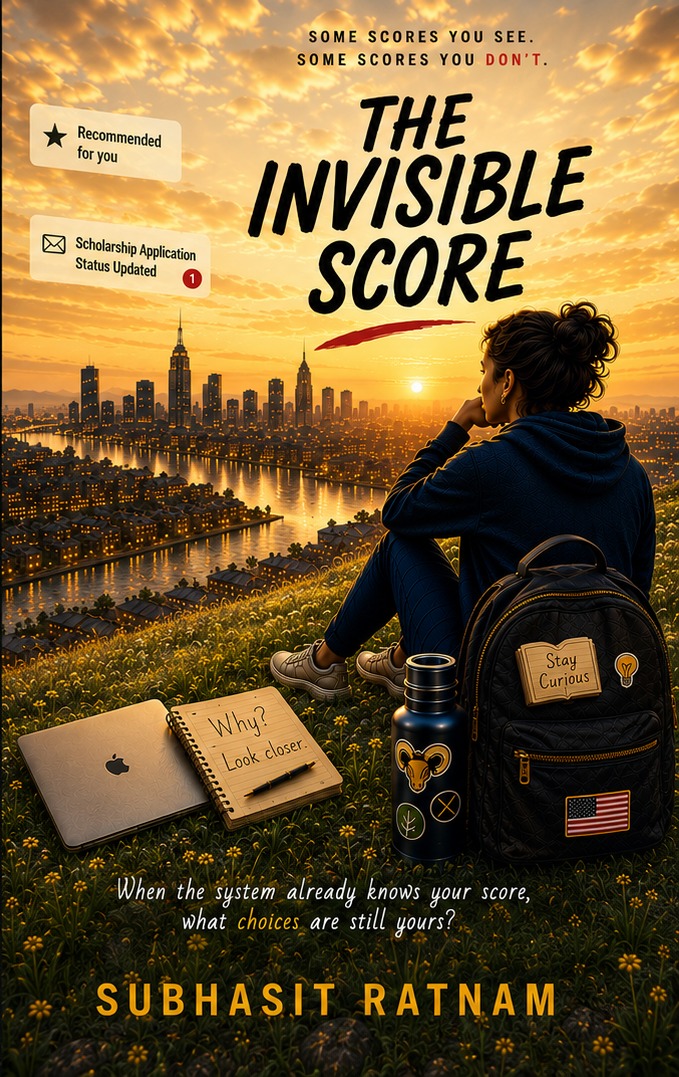
A companion to The Invisible Score

AI Glossary

A plain-English glossary of essential AI-literacy terms - written for readers aged 9+, and useful for parents, teachers, and librarians too.

  • ~15 minute read
  • Print Friendly
  • Free Educational Resource

This is the kind of glossary you dip into, not read cover-to-cover. Every term includes a plain-English definition, an everyday example, and a short note on why it matters.

If you already know a term, skip it. If a definition still feels fuzzy, that is a great question to bring to a friend, a parent, or a class discussion.

Section 01

A - E

Algorithm
A step-by-step set of instructions a computer follows to make a decision. – Example: A recipe is a real-world algorithm - do this, then this, then this. – Why it matters: Every recommendation, search result, or feed you see was ordered by an algorithm.
Artificial Intelligence (AI)
Software that learns patterns from data instead of following only fixed rules. – Example: An email app that quietly learns which mail you treat as spam. – Why it matters: AI now sits inside apps, phones, cars, and schools - understanding it is a life skill.
Bias
A tilt in a system that consistently favours one group or outcome over another. – Example: A voice assistant that mishears certain accents more often. – Why it matters: AI trained on biased data can quietly repeat those unfair patterns at scale.
Chatbot
A program you type or speak to that responds in natural-sounding language. – Example: A homework helper that finishes your sentence. – Why it matters: Chatbots feel like people, but they predict words - they do not truly understand you.
Cookie
A tiny file a website stores on your device to remember something about you. – Example: A shopping site remembering what was in your cart yesterday. – Why it matters: Cookies are how sites (and advertisers) recognise you across visits.
Data
Any information a computer can read, count, sort, or learn from. – Example: Your clicks, likes, search terms, and location are all data. – Why it matters: AI needs mountains of data - and your data is often part of it.
Dataset
A collected pile of data used to teach or test an AI system. – Example: Millions of labelled photos used to train an image recogniser. – Why it matters: The dataset shapes what an AI knows - and what it never learns.
Deepfake
A fake photo, video, or audio clip generated by AI that looks or sounds real. – Example: A video of a public figure saying something they never actually said. – Why it matters: Deepfakes make "I saw it with my own eyes" a weaker kind of proof than it used to be.
Digital Citizen
Someone who behaves online with awareness, kindness, and responsibility. – Example: Asking before you post a photo of a friend. – Why it matters: The internet is a shared space - digital citizenship keeps it worth being in.
Digital Footprint
The trail of data left behind by everything you do online. – Example: A search you made three years ago that a site still remembers. – Why it matters: Your digital footprint often lasts longer than you expect.
Encryption
Scrambling information so only the right person can read it. – Example: The little padlock next to a website address. – Why it matters: Encryption keeps private conversations, passwords, and payments safe.
Section 02

F - N

Filter Bubble
When an algorithm keeps showing you similar content until you rarely see other views. – Example: A social feed that only shows videos from one type of creator. – Why it matters: A filter bubble can quietly narrow how you understand the world.
Generative AI
AI that produces new content - text, images, sound, or video - instead of just sorting existing content. – Example: A tool that writes a poem or draws a picture from a short prompt. – Why it matters: Generative AI is powerful and easy to misuse - clarity about what is real matters more than ever.
Hallucination
When an AI confidently states something that is not true. – Example: A chatbot inventing a book title that does not exist. – Why it matters: AI can be wrong beautifully - always double-check facts that matter.
Large Language Model (LLM)
A big AI trained on huge amounts of text so it can predict the next word. – Example: The engine inside most modern chatbots. – Why it matters: LLMs are the reason AI now sounds so human - but they still guess, they do not know.
Machine Learning
A method of AI that learns patterns from examples rather than being told the rules. – Example: A spam filter that gets better as more people mark spam. – Why it matters: Machine learning is how most modern AI actually learns.
Metadata
Information about your information - the who, when, and where behind a file. – Example: The location tag saved with a phone photo. – Why it matters: Metadata can reveal more than the file itself.
Misinformation
Wrong information shared without the intent to deceive. – Example: A story your friend forwards that turns out to be an old rumour. – Why it matters: Kind people share misinformation all the time - slowing down helps.
Model
The trained "brain" of an AI system after it has learned from data. – Example: The AI model behind a photo-tagging app. – Why it matters: Every AI behaviour you experience comes from one model or another.
Neural Network
A layered structure of small maths units, loosely inspired by how brains work, used by most modern AI. – Example: The technology inside voice assistants and image recognisers. – Why it matters: Neural networks are why AI can suddenly do things it could not a decade ago.
Section 03

O - Z

Personalisation
When a system tailors what it shows you based on what it thinks you want. – Example: A homepage that looks different for two people on the same site. – Why it matters: Personalisation is helpful - and also how algorithms nudge your choices.
Phishing
A trick that pretends to be a trusted person or company to steal information. – Example: A fake bank email asking you to "verify" your password. – Why it matters: Phishing is the most common way ordinary people get scammed online.
Privacy
Your right to decide what parts of your life are yours alone. – Example: Keeping your location off in apps that do not need it. – Why it matters: Privacy is a default worth choosing - once shared, data is hard to pull back.
Prompt
The instruction you give an AI in your own words. – Example: Typing "explain gravity like I am nine" into a chatbot. – Why it matters: Better prompts get better answers - clear thinking still matters most.
Recommendation System
An AI that decides what to show you next. – Example: The "up next" video on a streaming service. – Why it matters: Recommendation systems shape what you notice - and what you never see.
Responsible AI
Building and using AI in ways that are fair, honest, safe, and accountable. – Example: A team explaining clearly how an AI made a decision. – Why it matters: Responsible AI turns "we could" into "should we?"
Search Engine
A tool that finds pages on the web that match what you asked for. – Example: Typing a question into a search bar. – Why it matters: The order of results is a decision - and someone (or something) made it.
Social Media
Apps and sites where people post and interact with each other. – Example: A video-sharing app with a feed of clips. – Why it matters: Social media is designed to keep you engaged - noticing that is powerful.
Spam
Unwanted or bulk messages, usually trying to sell, scam, or trick you. – Example: A stranger claiming you won a prize you never entered. – Why it matters: Spam filters and healthy scepticism are your best defence.
Training
The process of teaching an AI by showing it many examples. – Example: A picture recogniser looking at millions of labelled photos. – Why it matters: What an AI is trained on decides what it can - and cannot - understand.
Transparency
Being open about how a system works and what it uses. – Example: An app clearly labelling which posts are ads. – Why it matters: Transparency is how trust in AI is earned, not assumed.
Two-Factor Authentication (2FA)
An extra check - like a code sent to your phone - added to your password. – Example: A code from an authenticator app after you sign in. – Why it matters: 2FA blocks most account theft even if a password leaks.
Continue the Journey
Cover of The Invisible Score by Subhasit Ratnam

The Invisible Score

A story about the algorithms that quietly shape our lives.

Written for readers aged 9+ and their families, The Invisible Score follows Maya as she uncovers how AI, algorithms, and data quietly shape everyday decisions - through a story that stays with young readers long after the last page.

Scan to view the book
Continue Exploring